

Vol. 3 No. 1 (2012)
With great impetus we bring to public this fifth issue of Inquietude. Entering its third year of existence, the journal establishes itself as a vehicle for the production and dissemination of ideas from young students who restlessly yearn to be heard. This edition is a symptom of such restlessness, since we had the opportunity to receive and select, once again, a large contingent of texts from undergraduate and graduate students from most diverse universities in the country. This issue has, therefore, with eight articles written by students, a special publication coordinated by Professor Carla Milani Damião (Federal University of Goiás - UFG) together with students of the Study Group Kinosophia, an interview with Professor Vladimir Safatle (São Paulo University - USP) and the abstracts of the dissertations defended in the Graduate Program of UFG in 2011.
The reader can observe in the current issue a discussion around the Heideggerian concept of Dasein, where the author [Eliana Borges da Silva] analyzes how Heidegger operates the destruction, or deconstruction, of the traditional concept of existence, especially addressed by the Middle Ages ontology. Still in the phenomenological-existential background of contemporary philosophy, we find an article [by Aron Pilotto Barco] on Husserl that analyzes the meaning and the various nuances of the term "now" in Husserl’s theory. We know Heidegger’s philosophy influenced to some extent not only phenomenology, but also contemporary hermeneutics. In this record, we find in the present edition an approach [by Filipe Silveira de Araújo] on the aesthetic experience in hermeneutic thinking in light of the philosophy of Gianni Vattimo and the Gadamerian interlocutions.
For other areas of contemporary philosophy, the reader will encounter the problem of the concept of intentionality in Philosophy of Mind addressed [by André Rosolem Sant'Anna] through the perspective of John Searle and Daniel Dennett. And, in more diverse soils, you can benefit from the analysis of the concept of violence-power in the philosophy of Walter Benjamin [by José Gilardo Carvalho], as well as the Foucaultian notion of governmentality [by Leandro Alves Martins de Menezes].
Going to modern philosophy, a text [by Filicio Mulinari] on Kant invites us to enter the pre-critical period, where the first Kantian thoughts already outlined important later arguments about the concept and predicate of existence. And finally, we have a text on Rousseau, where the author [Heitor Pagliaro] investigates the philosopher’s conception of law and seeks to analyze to what extent we can qualify his theory as jusnaturalist.
In this edition, we have the first of a series of special publications related to the course given by professor Josef Früchtl at the UFG’s Faculty of Philosophy in August 2011. The course taught was based on his book The impertinent self. A heroic history of modernity and was translated and discussed by the Kinosophia Study Group, coordinated by Professor Carla Damião. The result of this study and discussion are three articles that Inquietude has the honor to publish and disseminate. The first of this triad is entitled Modernity, subjectivity, Hegel and the Western and addresses especially the association between the idea of the philosophical self to the figure of the hero found in some cinematographic genres.
On the occasion of the 14th International Festival of Environmental Cinema (FICA), which took place in Goiás City from June 26th to July 7th, we had the opportunity to conduct an inspiring dialogue with Professor Vladimir Safatle from USP. In the interview, we dealt with current issues, such as the strike of the Federal Universities professors, the case of Cachoeira, as well as issues like politics and culture.
The publication of this edition is the result of an intense work of the entire Editorial Staff, which has been significantly renewed. In the last edition we said goodbye to our executive editor, Carmelita Brito, and our chief editor, Adriano Correia. In their places, respectively, we now have the collaboration of Júlia Sebba (from the Philosophy Course of Goiás City) and Adriana Delbó, from the Faculty of Philosophy of UFG. Members who have been following this project since the first edition also said goodbye to us in the last number and then we received four new members to reinvigorate our work with their ideas and impulses. Our sincere thanks to Caius Brandão, Marcela Castanheira, Renato Mendes and Wigvan Pereira for their important contribution with Inquietude and our welcome to the new members: Heitor Pagliaro, Luana Xavier, Nádia Junqueira and José Ramos.
This number comes to public amid the strike that is spreading by the Federal Universities throughout the country. It is therefore with difficulties that we managed to launch this edition. Out of respect for the authors who sent us and entrusted their texts and out of respect for our established deadlines and calendars, we publish this issue - even at a time of negotiations and political reflections by professors and staff from IFES [Federal Higher-Education Institutions]. Our already traditional Launch event, organized with each new edition, was not held on the occasion of this issue due to the suspension of academic activities at UFG.
Finally, we would like to thank all those who contributed to the execution of this edition. To the professors and specialists who evaluated with attention the texts submitted to us, to the professors of the Faculty of Philosophy (FaFil) and the Course of Philosophy from the Campus of Goiás for the support and collaboration, to Professor Carmelita that continues always near helping us in this walk and, of course, to the authors who for now publish their texts and those who have sent us their articles. We invite all the restless youth to new submissions - without this our project would not thrive.
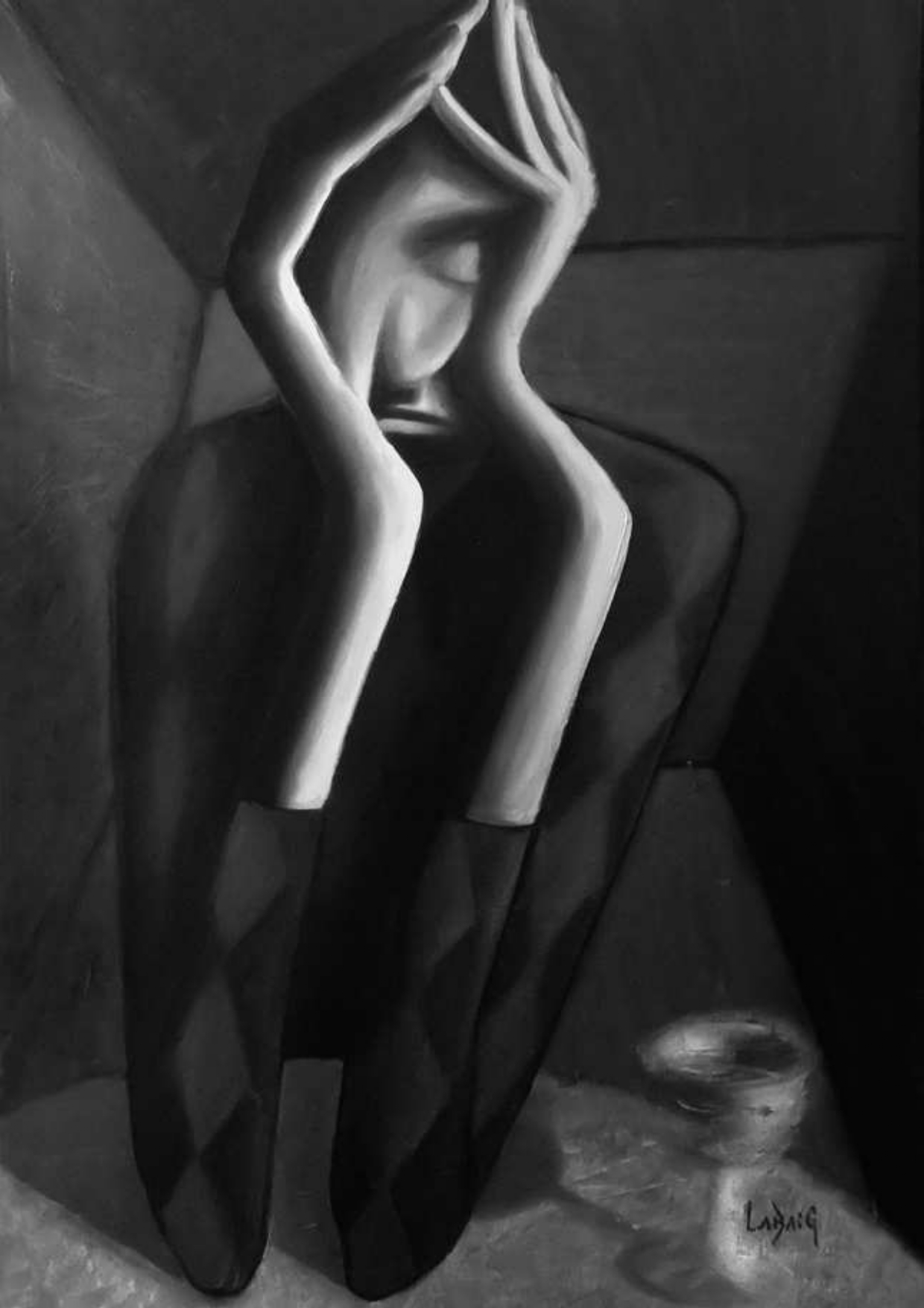
With a final invitation, we would like to close this editorial, calling the reader to begin their journey contemplating the figure that opens this edition: it is a painting entitled "The Problem", by Pedro Labaig - young painter who had been part of our editorial staff in the first two editions. The painting draws us to think what is the meaning of philosophy without problematizing it, what is the meaning of philosophy that does not torment with what touches us. The figure calls us to collect on ourselves and to thresh ourselves onto what challenges us - this is the exercise of the restless philosophizing the reader will do in the sequence. Good (and restless) reading!
We say goodbye with renewed impetus for the next numbers and meetings.
The Edition
Published:
2012-07-07