

Vol. 16 No. 2 (2025): Dossier "Philosophy and Psychoanalysis"
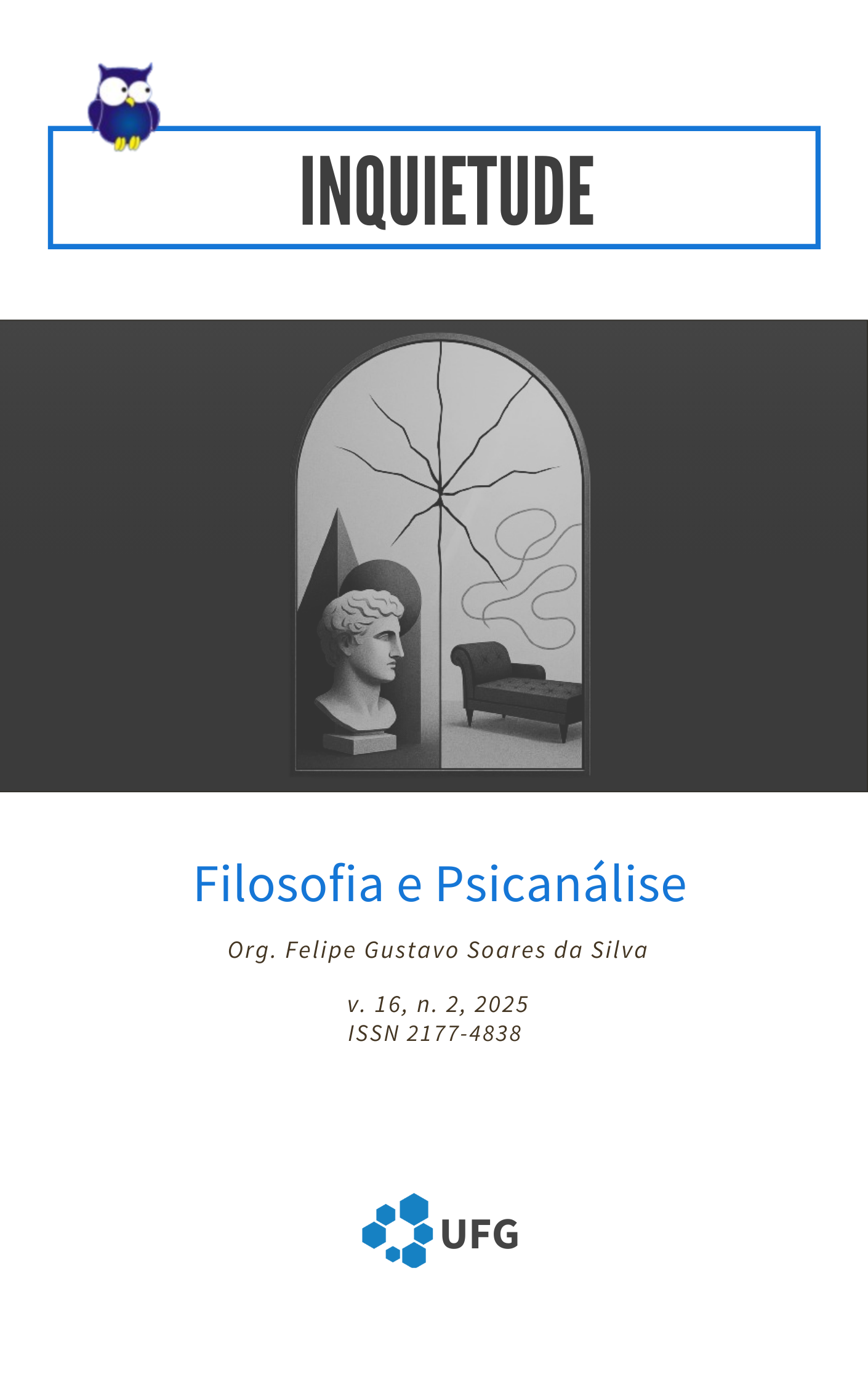
With immense joy Inquietude presents to the academic community, and other interested people, the dossier "Philosophy and Psychoanalysis", reaffirming the relevance of psychoanalysis as a fundamental tool for understanding social phenomena and modes of subjectivation in the contemporary world. How do you remember Élisabeth Roudinesco in Why psychoanalysis? , it is a field that, by questioning the unconscious, illuminates both the impasses of the subject and the collective, political and cultural dilemmas of our time. The articles gathered here explore this critical and interpretative power in dialogue with philosophy, revealing the indispensability of psychoanalysis to think about human behavior and the contradictions of modernity.
Opening the dossier, Samuel Rodrigues and Evandro Cherer develop an anti-philosophical reading in Lacanian psychoanalysis, showing how Lacan rejects ontology inherited from the western tradition and affirms that being exists only as a discourse effect. In the following, Weslley Rodrigues revisits the confrontation between Descartes and Freud: while the former supports the substantiality of the subject, the latter understands it as an associative and functional complex, which highlights the originality of psychoanalysis compared to Cartesianism. Bruno Werneck approaches Nietzsche and Freud through the aesthetic of the tragic, revealing how both capture dissonance and contradiction as central marks of modernity. With attention to the symbolic, Flavia Bonfim examines the use of myths in Freud and Lacan, showing myth as a way of conceptual transmission and as a structure that touches the real. Aline Brasiliense discusses time in the Freudian unconscious, from the concept of Nachträglich, emphasizing its own non-linear temporality. Lucas Latorraca brings the metaphor of the "alchemical laboratory", inspired by Jung and Nise da Silveira, to highlight the symbolic power of active imagination and art therapy. Closing the dossier, Adelson Soares reflects on the psychological trauma of racism in dialogue with Fanon, Freud and Césaire, revealing its psychic effects and the possibilities of resistance.
Together, the articles reaffirm the vitality of the encounter between philosophy and psychoanalysis, offering the reader a plural and deep panorama of contemporary ways of thinking about the human.
Prof. Dr. Felipe Gustavo S. da Silva
**********************************************************************************************
PHILOSOPHICAL-SCIENTIFIC EDITORIAL STAFF (NOMINATA)
Abel dos Santos Beserra (USP, São Paulo, SP, Brazil)
Alice Parrela Medrado (UNIMONTES, Montes Claros, MG, Brazil)
Allan Mohr (UTFPR, Curitiba, PR, Brazil)
Ana Flavia Cicero Conde (UEM, Maringá, PR, Brazil)
Carlos Henrique Kessler (UFRGS, Porto Alegre, RS, Brazil)
Elisangela Carmo (UNESP, Rio Claro, SP, Brazil)
Fabíola Menezes de Araújo (UFRJ, Rio de Janeiro, RJ, Brazil)
Fernando Cézar Bezerra de Andrade (UFPB, João Pessoa, PB, Brazil)
Marcus Vinicius Neto Silva (UFMG, Belo Horizonte, MG, Brazil)
Paulo José da Costa (UEM, Maringá, PR, Brazil)
Rafael Teruel Coelho (USP, São Paulo, SP, Brazil)
Robson Stigar (SEED-PR, Curitiba, PR, Brazil)
Simone Borges dos Santos (UFBA, Salvador, BA, Brazil)
Valéria de Angelo Ghisi (UP, Curitiba, PR, Brazil)
Vítor Hugo Reis dos Reis Costa (UERJ, Rio de Janeiro, RJ, Brazil)
Waldemar Magaldi Filho (IJEP, São Paulo, SP, Brazil)
Weiny César Freitas Pinto (UFMS, Campo Grande, MS, Brazil)
Published:
2025-11-24