

Vol. 11 No. 2 (2020)
The challenges faced for the maintenance of a journal of humanities are numerous and continuously reinforced by policies that irresponsibly disregard the social importance of the human sciences; with Inquietude journal is no different. It is considering the political context that the interview with Heitor Pagliaro, current executive editor of Inquietude, moves and worries us. Since its creation - he says -, the magazine seeks to be a place of speech, a space that is important also for the development of other sciences: "if we want the Brazilian science to have greater international competitiveness and that the Brazilian journals have a greater 'impact factor', we need to value the scientific publishing work done in the country, with funding and infrastructure". Heitor Pagliaro, who has accompanied the magazine since its creation, concludes the celebrations for the 10 years of Inquietude.
The articles of this edition have as scope the themes of metaphysics and knowledge theory. Who opens our series of carefully selected articles is a woman, Tatiana Betanin, bringing the Heiddegerian understanding of the concept of metaphysics. Although it works with specific terms, the comprehensibility of the text is commendable. Tatiane Betanin, at the same time that she digs and aligns concepts, questions formulations. This movement allows her, together with Heidegger, to answer the meta + physics equation, whose result is philosophy itself. In addition to the explanatory excellence, by conceptualizing metaphysics according to Heidegger, the author’s high point is in the reassessment of what philosophy is. The idea of estrangement, astonishment or, as she puts it, restlessness, is the necessary tool "to philosophize in these new times".
The discussion about Heidegger returns in the article of Raphael Pegden, now focused on a critique of the metaphysics of substance and the metaphysics of the subject, which accompanies a criticism of the theories of knowledge by Descartes, Kant and Husserl. The destruction of the history of ontology, proposed by Heidegger, says of an ontology that obscures the original question about being. The fundamental ontology is then presented as background of all ontology and resurgent through this destruction of what has been petrified by history. Retracing the path taken by the history of philosophy is fundamental to substantiate this criticism, and in doing so, Raphael Pegden delineates the gulf between the fundamental ontology and what Descartes proposes as ontology in cogito, where the being of substance cannot be known. A res extensa does not solve the problem for Heidegger, because there remains the question of presence and entities intramundanos. Thus, "Heidegger’s critique consists in showing that space is not a place and the world is not an object [...]: we all exist in such a way that we are in a world, says Heidegger". The critique of Kant is formulated from this same point: the transcendental subject assumes the subject as an epistemological foundation for the problem, dodging to be-in-the-world, or to be with the world.
The next question we bring concerns the philosopher Schopenhauer. In The incorporation of the Platonic idea in Schopenhauer’s metaphysical system, Jefferson Teodoro expands important concepts of metaphysics and at the same time devotes himself to important details for the elaboration of his argument. Punctuating the details of Platonic theory and the evident differences in the way of doing philosophy, the author goes from the principle of reason, contained in the Platonic Idea, to Kant’s rationalizing materialism. The connection between Plato and Kant is given, according to Schopenhauer, by the relationship between Idea and the thing itself, but the overcoming of Plato’s Kantian reading is the great turn of the text. In the concept of blind impulse of the Will, the author shows how Plato’s Theory of Ideas is also alien to the principle of reason. The new system proposed by Schopenhauer is thus grounded, and the immediate representation, that is, that one free from the principle of reason, leads the text to a discussion about beauty.
Douglas de Jesus, in Kant and the testimony, works the concepts of reductionism and non-reductionism to comply with the dualism between validation and denial of the testimony, that is, between the verification on the one who witnesses and the presentation of evidence to reject it. In a nutshell, reductionists are those who "argue that it is necessary for the rational basis for testimony to be reduced to other sources of belief (memory, perception or inferential reasoning)", and non-reductionists are those who "reject the thesis of the necessity of reduction, although there may be non-reductionists who accept the possibility of reduction". The author transits between these concepts with the help of epistemologists - as he writes himself - until reaching Kant, when the question about the validation of the testimony becomes elusive. By composing the "thinking for yourself", could we say that Kant is a reductionist? It is necessary to analyze the proposition in question from a more comprehensive perspective, a task that Douglas de Jesus fulfills with skill.
The next text is by Luis Oliveira who, in The limits of hilemorfism and the concept of transubstantiation in Thomas Aquinas, departs from Aristotle’s Physics to talk about what is substance and what is transubstantiation. The writing binds us to the text, which is guided by a Christian position: the presence of the body and blood of Christ during the mass. There are several possibilities of questions about this presence and, for each answer, new questions are asked. For example, to know whether or not there is the presence of the body of Christ in bread and wine, and if there is this presence, how about the matter bread and wine? Finally, the various questions that can be formulated from this simple act show how religion is a source of philosophy, at the same time they show how philosophy distanced itself in its discussions from the very act of faith.
This edition of Inquietude also has a text with an experimental writing, produced by Hercules da Silva Neto. In Nietzsche and science: Experimental living, the author assumes Nietzsche's style and proposes to enter into the freedom that breaks the shackles of standards, including the way of thinking science. It takes flexibility to understand the purpose of the text, which is directed exactly to this point: to become flexible. It is in this sense that idea and language are found, bringing to the surface an eminently transformative text.
Finally, the editorial decided to bring the second author of this edition: Elisa Oliveira. She, who transits between philosophy and psychology, dares a critique of the tradition of psychoanalysis, a criticism that is built from the philosophy of Nietzsche. Freedom in Nietzsche: A critique to psychoanalysis theory of desire is a therapeutic article, because reading brings the desire to launch into unknown horizons, abandoning certain sickly characterizations during life. The author tells a new way of thinking about psychoanalysis that, hovering over the future, emancipates and rediscovers itself.
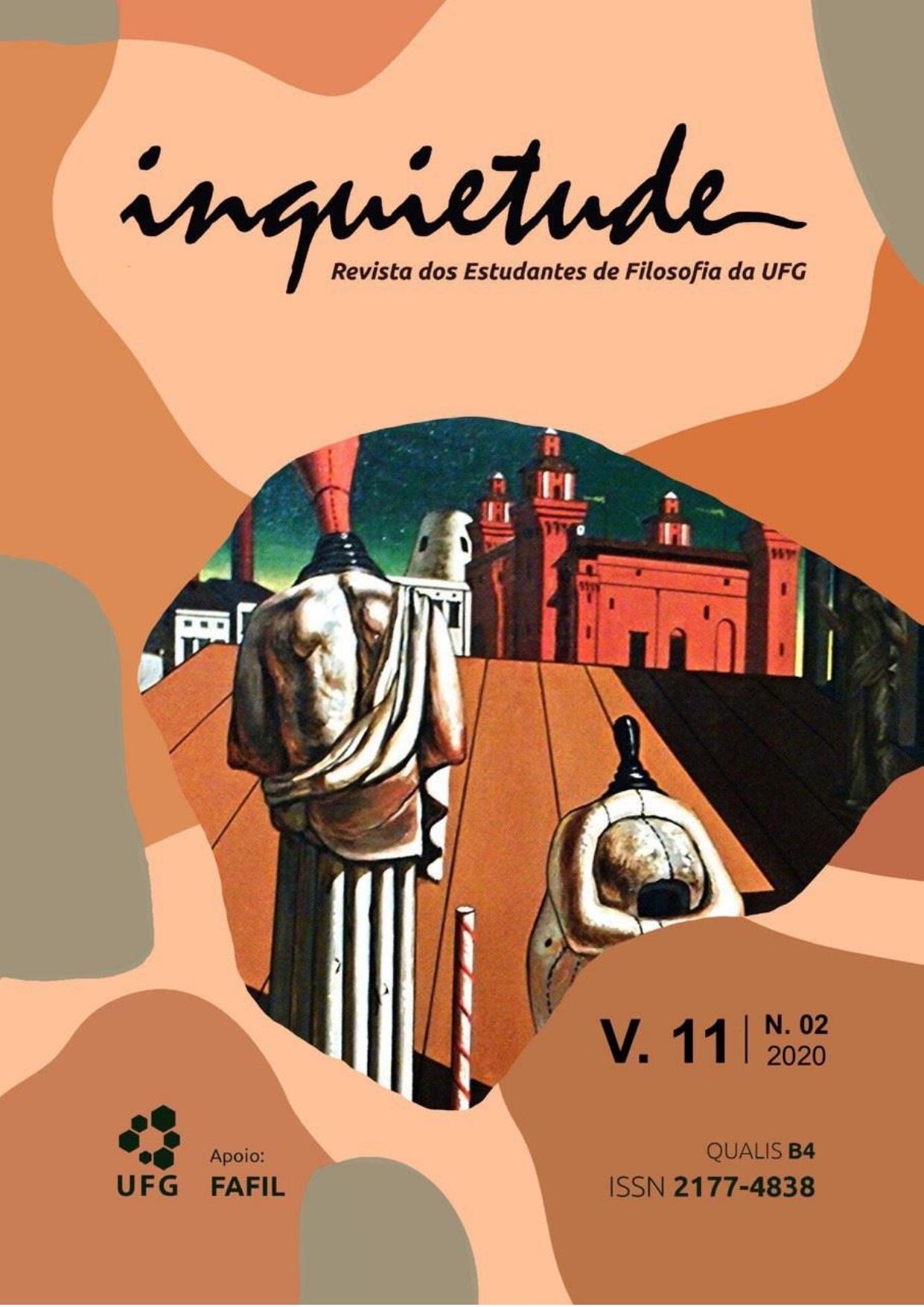
This is a long-awaited edition that has been carefully prepared in its details. The image chosen for the cover is the painting by Giorgio de Chirico, who was part of a movement called "metaphysical painting". The disturbing muses gloriously illustrates this edition, which talks about politics, subject, church and freedom, questioning reason, history and the future. The theme of metaphysics is wide and open, and an edition that proposes to both will always be disturbing. We hope that the reading will be magnifying.
Sincerely,
The Editorial Team of Inquietude.
Angélica Carvalho Sant'Anna
Published:
2021-10-22